From tomato skins to furniture edges: Bonlex Europe starts extruding the First Bio-Based Prototypes for POLYMERS-5B
The decorative foil manufacturer is taking polymers born from agri-food waste out of the lab and onto a real extrusion line, starting with edge bands for MDF and chipboard panels.
Look at the edge of a kitchen cabinet, a wardrobe door or a bathroom vanity and you’ll probably find a thin plastic strip neatly glued along the panel. It’s one of the most overlooked components in interior design, and soon it may be one of the first to change what it’s made of.
Bonlex Europe, a producer of decorative polymer foils for furniture and interiors, is among the partners of POLYMERS-5B, a project that turns agri-food waste such as tomato skins, olive residues and wood pulp into bio-based polymers that could one day replace traditional plastics.
Bonlex already works across a range of materials, from conventional PVC and PET to more sustainable alternatives such as bio-PVC and recycled PET. Its approach combines Japanese technology with Italian design, and its mission has stayed the same: creating beautiful living spaces in harmony with the environment.
The industrialization challenge
Within the consortium, Bonlex is responsible for industrialization. That means answering one of the toughest questions any new material faces: can it actually run in a real production process?
A bio-based polymer can perform well at laboratory scale and still fail under industrial conditions. Melt behaviour, processing temperatures, dimensional stability and surface quality all have to work together before a material can become a product. Bonlex’s job is to find out whether and how the new POLYMERS-5B polymers can meet those demands.
Why edge bands come first
The company chose to start with edge bands, the strips applied to the edges of MDF and chipboard panels. They are a practical first test. Edge bands are produced at high volumes, used across almost every furniture segment, and have to protect the panel while matching the look of the surface.
The first prototypes will be produced on a laboratory extrusion machine, which is the step that links material research to manufacturing. As the Bonlex team puts it, a material only matters when it works in real production, not just in the lab.
Watch the video
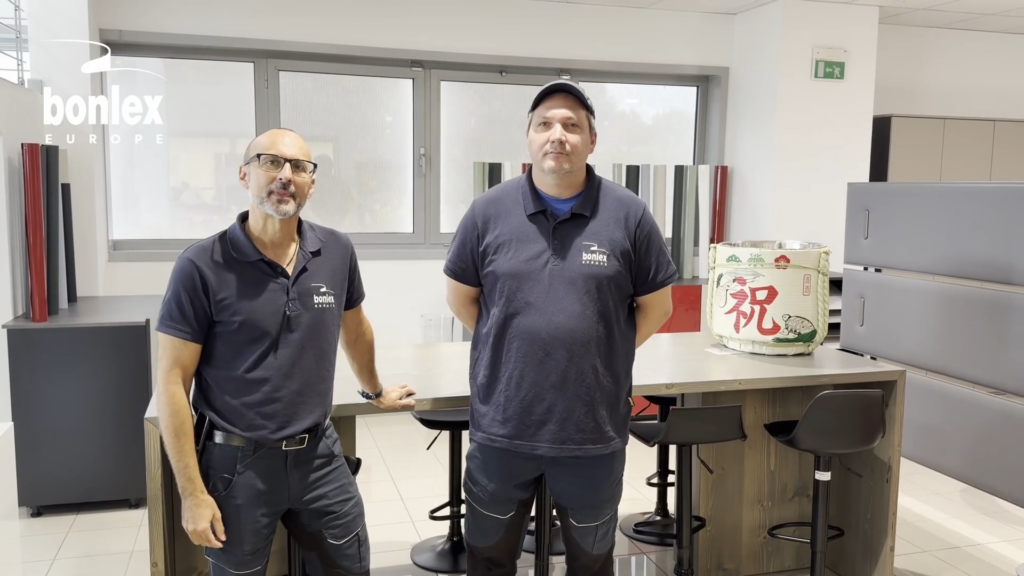
Want to see where it all begins? Bonlex Europe introduces its role in the project and the extrusion line that will produce the first bio-based edge band prototypes in a short video.
Watch it now on the POLYMERS-5B LinkedIn page.