EUBCE 2026 Special Edition | 19-22.05.2026
NSBproject presented the project’s latest advances at the 34th European Biomass Conference and Exhibition in The Hague, showcasing a pilot-validated biorefinery platform that cuts CO₂ emissions by 50% while delivering engineering-grade mechanical performance.
The Hague, 19–22 May 2026 — POLYMERS-5B was among the EU-funded research projects in the spotlight at EUBCE 2026, the 34th European Biomass Conference and Exhibition held at the World Forum in The Hague, Netherlands. Project partners Prof. Luis Fonseca (IST-ID/IBB, Portugal) and Andrea Jester and Riccardo Varotto (NSBproject S.r.l., Italy) presented a scientific poster titled “From Agri-Food Residues to High-Performance Sustainable Polymers: The POLYMERS-5B Pathway Toward Circular Bioplastics“ (Poster IDV.3.35, Work ID: W30705).
A biorefinery built on waste
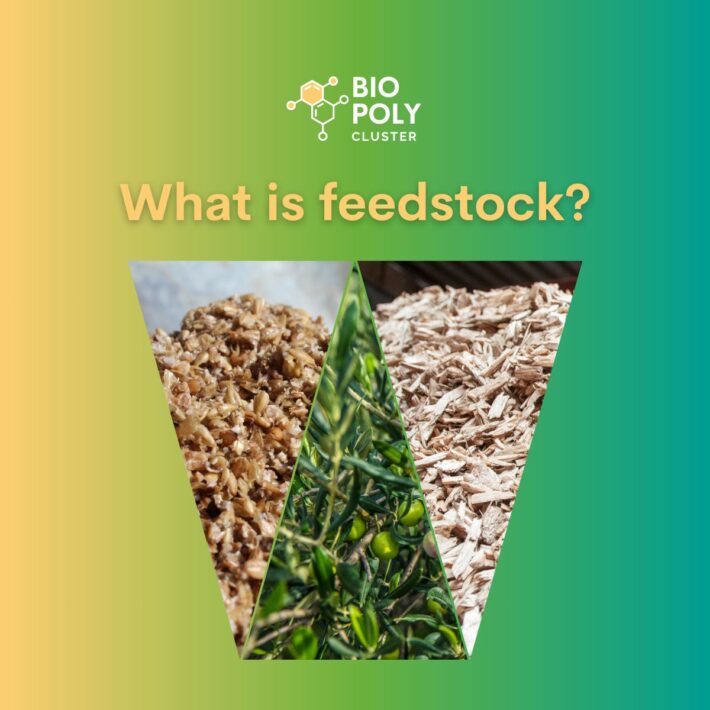
The presentation illustrated how POLYMERS-5B converts two major Mediterranean agri-food by-products — tomato pomace and olive pomace — into engineering-grade bio-based polyesters through a cascaded sequential extraction approach. The platform uses enzymatic polycondensation and ultrasound-assisted extraction to maximise monomer yield while avoiding petrochemical solvents and metal catalysts, in full alignment with the EU’s Safe and Sustainable by Design (SSbD) framework.
The feedstocks are not incidental: the EU generates approximately 120 million tonnes of agri-food waste per year. POLYMERS-5B taps into this largely untapped second-generation reservoir, using 100% waste-derived inputs and creating no competition with food and feed supply chains.
Pilot-scale results confirmed
The poster reported the achievement of Technology Readiness Level 5 (TRL 5), with reproducible 15 kg pilot batches validated at IST-ID/IBB’s facilities in Lisbon. Key performance indicators confirmed the platform’s industrial viability:
−50% CO₂: footprint vs fossil baseline (cradle-to-gate LCA)
≈2 GPa: Elastic modulus — structural parity with PET & PC
≥80°C: Glass transition temperature for demanding end-uses
TRL 5: Pilot scale, 15 kg reproducible batch
Competitive positioning through AI-driven intelligence
NSBproject‘s contribution went beyond dissemination. As the project’s Innovation Broker, the Italian partner presented results from its proprietary C-Tech Navigator — an AI-driven competitive intelligence methodology — which benchmarked POLYMERS-5B against the leading bio-based polymer technologies on the market, including Avantium’s PEF and Nenuphar’s PHA.
“By identifying that Avantium’s PEF is optimised primarily for the packaging industry and that Nenuphar’s PHA is optimised for biodegradability, the C-Tech Navigator enabled POLYMERS-5B to adapt its go-to-market strategy towards other industrial sectors where the relevant applications were identified.” — Andrea Jester, NSBproject S.r.l.
The analysis identified a specific market gap for bio-based polymers derived from non-food, low-value agro-waste that can achieve an elastic modulus of approximately 2 GPa — a performance threshold relevant for structural applications in automotive and technical textiles.
Target markets and value chain
The bio-based polyester platform developed in POLYMERS-5B targets a €14 billion+ addressable market in Europe currently served by fossil-derived PET, polyamide, and polycarbonate grades. Four application sectors are in focus: high-tenacity fibres for technical textiles and fashion; bio-composite panels and interior components for the automotive sector; barrier films and flexible packaging suitable for food-grade applications; and functional resins for surface coatings.
EU Project Cluster positioning
The poster also situated POLYMERS-5B within the EU bio-based polymer research landscape, demonstrating how the project advances beyond the state of the art established by related initiatives such as OLinWASTE, OLEAF4VALUE, and POLYMATOS. The differentiating factor: POLYMERS-5B is the first integrated platform to simultaneously valorise both tomato and olive matrices within a single biorefinery cascade, while maintaining the highest sustainability scores in the cluster.
Press review
Gallery