POLYMERS-5B at SETAC Europe 35th Annual Meeting 2025 | 12-15.05.2025
The POLYMERS-5B project was presented at the SETAC Europe 35th Annual Meeting, held in Vienna (Austria) from 12 to 15 May 2025 and organized by the Society of Environmental Toxicology and Chemistry (SETAC). The annual meeting brought together scientists, industry experts, and policy stakeholders to discuss the latest advances in environmental science, sustainability, and chemical safety.
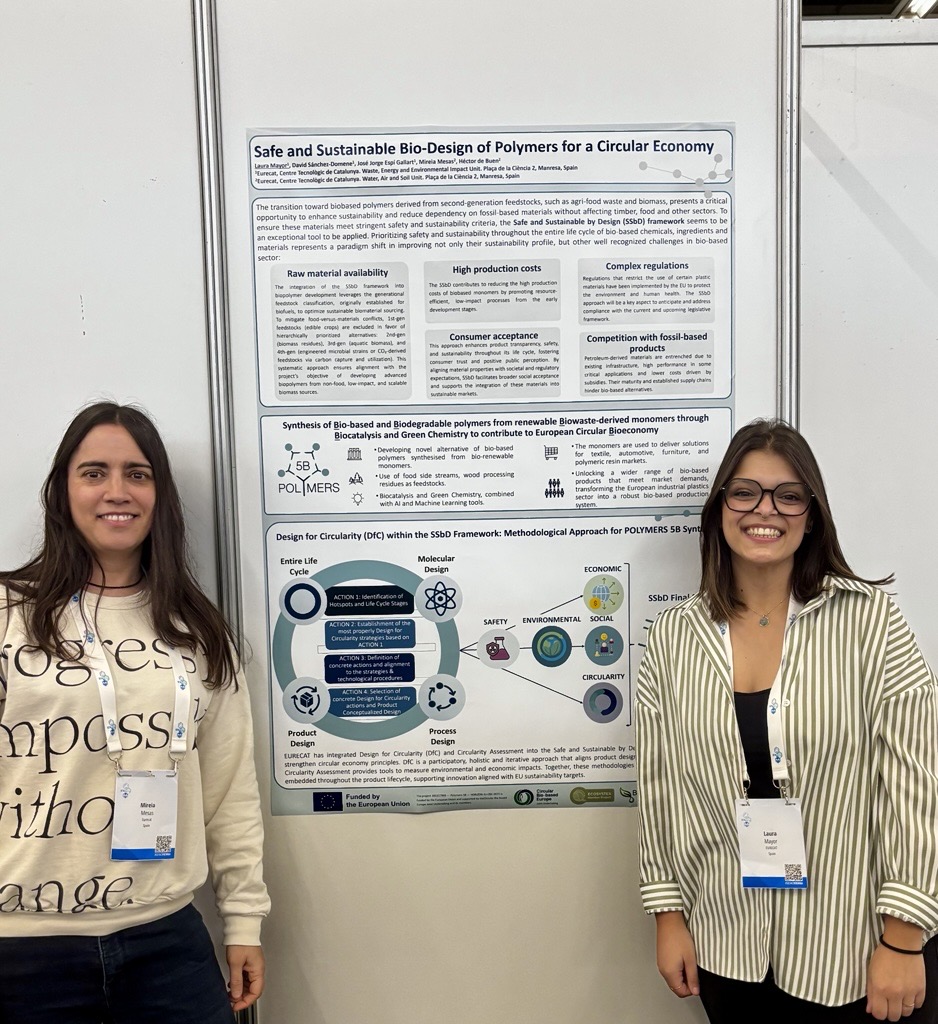
Within this context, POLYMERS-5B contributed to the scientific programme with a poster entitled “Safe and Sustainable Bio-Design of Polymers for a Circular Economy.” The poster illustrated the project’s approach to integrating Design for Circularity (DfC) and Circularity Assessment into the Safe and Sustainable by Design (SSbD) methodology, supporting the development of bio-based polymers aligned with circular economy principles.
Participation in SETAC Europe 2025 provided an important opportunity to share the POLYMERS-5B methodological framework with the wider environmental and sustainability research community, fostering dialogue on how SSbD can be effectively operationalised to ensure safety, sustainability, and circularity across the entire life cycle of polymeric materials.
Poster Abstract
Safe and Sustainable Bio-Design of Polymers for a Circular Economy
The transition towards bio-based polymers derived from second-generation feedstocks, such as agri-food waste and residual biomass, represents a key opportunity to reduce dependence on fossil-based materials while avoiding competition with food and timber resources. To ensure that these materials meet high safety and sustainability standards, the Safe and Sustainable by Design (SSbD) framework is applied within the POLYMERS-5B project as a guiding methodology throughout the entire life cycle of polymers.
In this context, Design for Circularity (DfC) and Circularity Assessment are integrated into the SSbD framework to strengthen circular economy principles. DfC provides a holistic, participatory, and iterative approach that aligns material and product design with circular strategies, while Circularity Assessment enables the evaluation of environmental and economic impacts, supporting evidence-based decision-making. This combined approach allows the identification of critical life cycle hotspots, the definition of appropriate circular strategies, and the implementation of concrete actions at molecular, process, and product design levels.
By leveraging bio-renewable monomers obtained from non-food biomass and applying biocatalysis, green chemistry, and advanced digital tools, POLYMERS-5B demonstrates how the SSbD framework can support the development of safe, sustainable, and circular polymer solutions. This integrated methodology contributes to regulatory readiness, improved consumer acceptance, and enhanced competitiveness of bio-based polymers, supporting the transition towards a resilient European circular bioeconomy.